


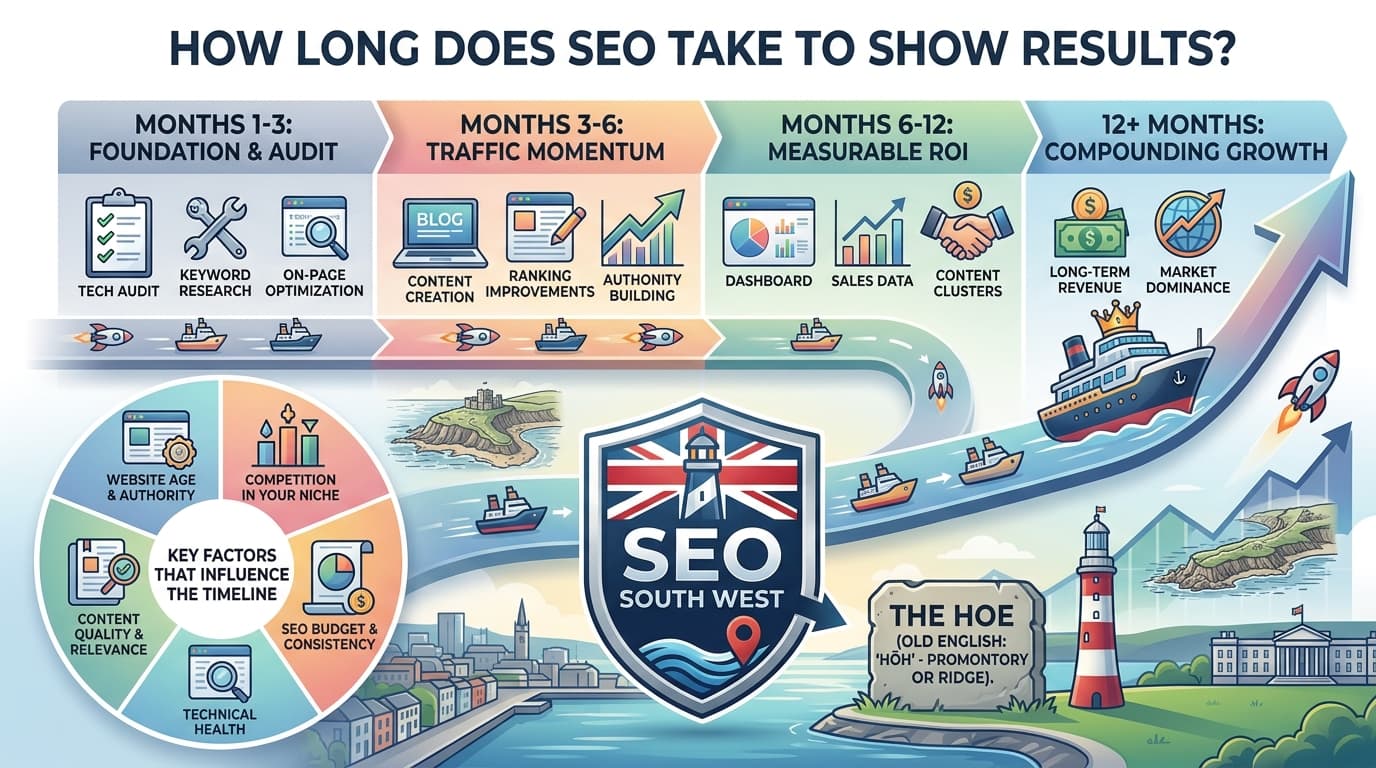
SEO commonly takes several months to produce meaningful improvements, but there is no fixed timeline that applies to every website. Some businesses may notice early progress within a few weeks, while stronger gains in rankings, organic traffic and enquiries often take longer.
The speed of the results depends on the condition of the website, the competition in its market, the keywords being targeted and the amount of work required. A technically sound website with existing authority may progress faster than a new website or one affected by serious SEO problems.
Understanding these factors makes it easier to set realistic expectations and judge whether an SEO campaign is moving in the right direction.
When Can You Expect to See SEO Results?
SEO progress usually happens in stages rather than through one sudden increase in rankings.
During the early stages, the work may involve:
- Reviewing the website’s technical condition
- Fixing crawling and indexing problems
- Researching relevant search terms
- Improving existing pages
- Creating missing service or supporting content
- Strengthening internal links
- Improving local search signals
- Building the website’s authority
Some of these changes can have a relatively quick impact. For example, fixing an indexing problem may allow an important page to begin appearing in search results. However, competitive rankings normally require consistent improvements over time.
It is helpful to separate early SEO activity from meaningful business results. A page moving from position 80 to position 35 is progress, but it may not yet generate many visitors or enquiries. The commercial impact generally becomes more noticeable when important pages reach stronger positions.
Why Does SEO Take Time?
Search engines need time to discover, crawl, process and evaluate website changes. They also consider how a page compares with other available results.
Your website is rarely competing against an empty search results page. Other businesses may already have established websites, detailed service pages, relevant links, customer reviews and years of search history.
SEO therefore involves more than placing a keyword on a page. A website must demonstrate that it is relevant, useful, technically accessible and a suitable result for the searcher.
Improvements may need to accumulate before a page moves significantly. This is why SEO is better treated as an ongoing process than a one-off website edit.
What Affects the SEO Timeline?
The Current Condition of Your Website
A website with a clear structure, indexable pages and useful content provides a stronger starting point. If the site has technical errors, duplicated pages, weak content or confusing navigation, those issues may need to be resolved before it can compete effectively.
An established website may already have some authority and useful rankings. In that situation, improving existing pages can sometimes produce results faster than starting from scratch.
The Competitiveness of Your Market
The difficulty of SEO depends partly on the businesses already ranking for your target searches.
A local service with limited competition may be easier to improve than a highly competitive industry where established companies have invested in SEO for years. Broader searches also tend to be more competitive than specific services or detailed customer questions.
This is why a good strategy should prioritise realistic opportunities rather than targeting every possible keyword at once.
The Keywords Being Targeted
Different keywords can require different timescales.
A highly specific search may have fewer competing pages and a clearer intent. A broad commercial term is likely to attract more competition and require stronger content, authority and relevance.
The objective should not be to rank for the largest possible number of phrases. It should be to improve visibility for searches that are relevant to the services the business actually provides.
Website Age and Authority
A new website has limited search history. Search engines need time to discover its pages, understand its structure and assess its relevance.
Older websites may progress faster if they already have useful content and credible links. However, age alone does not guarantee good rankings. An established website with years of technical or content problems may still require substantial work.
Content Quality and Search Intent
A page must answer the reason behind a search.
For example, someone searching for a service normally expects a clear commercial page explaining what is available, where it is offered and how to make an enquiry. An informational article would not necessarily satisfy that intent.
Matching each keyword to the correct page type helps search engines understand which page should rank. It also reduces the risk of several pages competing for the same search.
Technical SEO
Technical problems can slow down or prevent progress. Common areas that may need attention include:
- Pages blocked from crawling
- Important URLs excluded from indexing
- Broken internal links
- Duplicate pages
- Poor mobile usability
- Slow page performance
- Incorrect redirects
- Confusing website architecture
If organic visibility is being restricted by an underlying problem, an SEO audit can help identify what needs to be corrected.
Consistency of the SEO Work
SEO usually performs better when improvements are implemented consistently.
Publishing one page and then leaving the website unchanged for months is unlikely to build strong momentum. Regular optimisation allows the site to cover relevant topics, improve weaker pages and respond to changes in search behaviour and competition.
Can SEO Produce Quick Wins?
Quick wins are possible, but they should not be mistaken for guaranteed instant rankings.
Potential early opportunities can include:
- Improving pages already appearing close to stronger positions
- Fixing pages that are not indexed correctly
- Updating weak titles and headings
- adding relevant internal links
- Consolidating pages that target the same intent
- Improving local business information
- Expanding pages that do not adequately cover their subject
These actions may help a website progress sooner, particularly when it already has some visibility. However, quick wins form one part of a wider SEO strategy rather than replacing it.
How Should SEO Progress Be Measured?
Rankings are useful, but they are not the only measure of performance.
A practical SEO review should consider:
- Whether important pages are indexed
- Changes in impressions and clicks
- Movement for commercially relevant searches
- Growth in organic visits to service pages
- Local search visibility
- Enquiries generated through organic traffic
- Improvements in user engagement and conversions
Search visibility may improve before traffic increases substantially. Similarly, traffic can grow without producing enquiries if visitors are reaching irrelevant pages or the website does not make the next step clear.
The aim is not simply to attract more visitors. It is to attract appropriate visitors and help them find the information or service they need.
Should You Stop SEO If Results Are Slow?
Slow results do not automatically mean the campaign is failing. The important question is whether there are signs of progress and whether the work addresses the right priorities.
A campaign should be reviewed if:
- Important pages remain unindexed
- Relevant impressions are not increasing
- The same work is repeated without a clear reason
- New pages overlap with existing ones
- Rankings improve only for irrelevant searches
- Traffic increases without supporting enquiries
- Technical recommendations are never implemented
SEO requires patience, but it should still be accountable. The strategy, completed work and changes in performance should be clear enough to evaluate.
How Long Should a Business Commit to SEO?
Businesses should approach SEO as a medium- to long-term marketing channel rather than expecting a fixed result by a specific date.
The appropriate commitment depends on the website, competition and objectives. A business seeking visibility for several competitive services will usually need more sustained work than one targeting a narrow local opportunity.
The first phase should establish a strong foundation. Later work can build upon it through service-page improvements, supporting content, internal linking, local optimisation and authority development.
Start With a Realistic SEO Strategy
There is no honest way to guarantee that every website will achieve a particular ranking within a set number of weeks. The timeline depends on the starting position and the strength of the competing search results.
What can be controlled is the quality and consistency of the work: resolving technical barriers, targeting the correct searches, improving important pages and measuring progress against meaningful business goals.
If you want to understand what may be limiting your website, explore our SEO services for Plymouth businesses and arrange an initial discussion. We can review your current position and identify the areas most likely to influence future organic growth.