


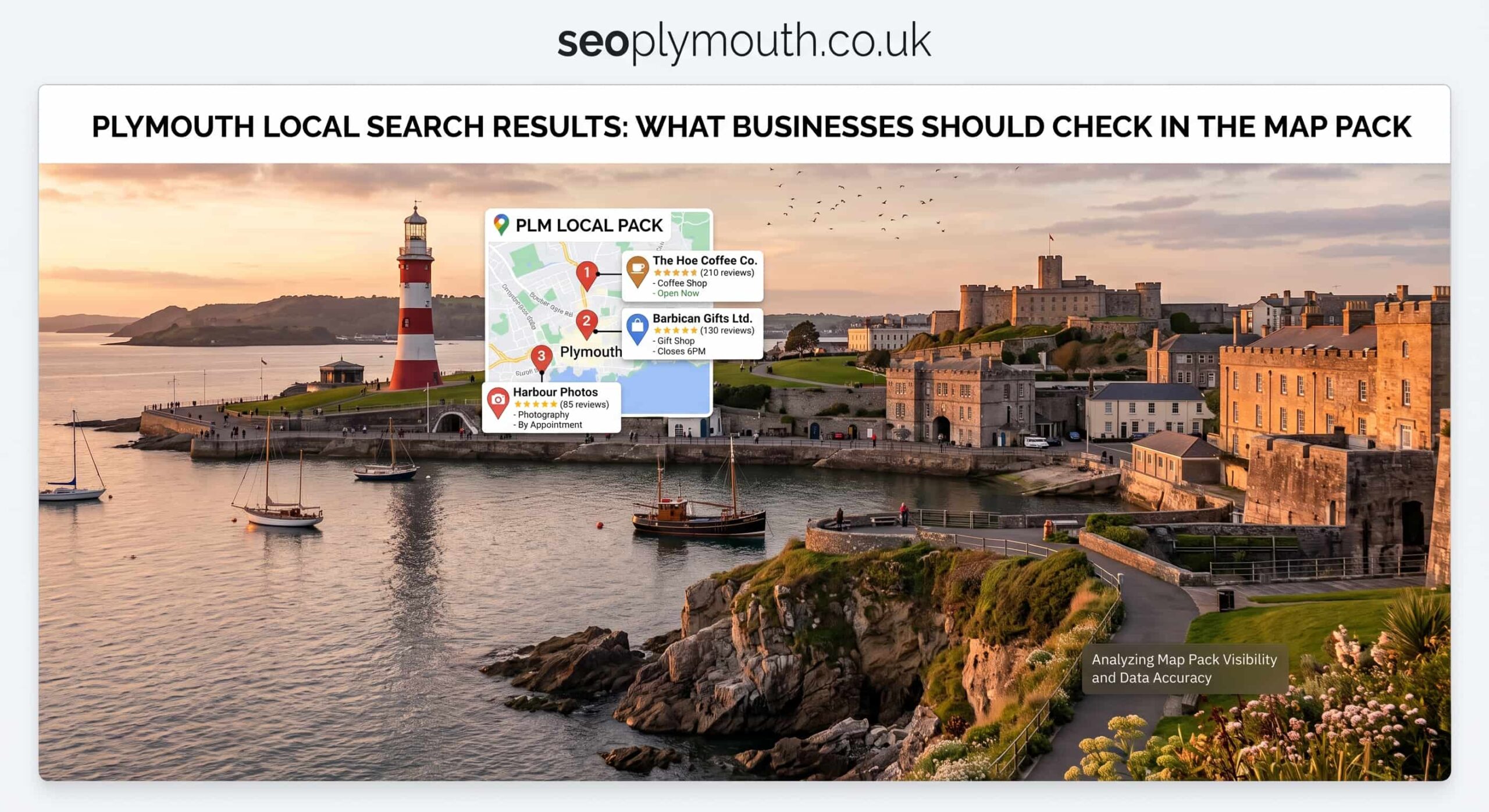
Plymouth local search results should be analysed across different services, locations and devices rather than judged from one search. The businesses appearing in the map pack can change according to relevance, distance, prominence and the searcher’s location.
A company searching for itself from its office may see a different result from a prospective customer searching in Plympton, Plymstock or another part of the Plymouth area.
This guide explains what businesses should record when reviewing the map pack, how to compare local competitors and how to turn those observations into practical priorities.
It is an analysis framework, not a claim that every visible feature is a confirmed Google ranking factor.
The Short Answer
When reviewing Plymouth local search results, check:
- Whether a map pack appears
- Which businesses occupy the three visible positions
- Their primary Google Business Profile categories
- Their locations relative to the searcher
- Their review counts, ratings and review recency
- Whether they have complete service information
- Which website pages are connected to their profiles
- Whether they also rank organically
- Which directories appear below the map pack
- How the results change across different parts of Plymouth
The most useful comparison is not “What does the top business have that I do not?” It is “Which recurring differences appear across several relevant searches?”
What Is the Google Map Pack?
The map pack is the group of local business results Google may display for searches with local intent.
It commonly includes:
- Business name
- Rating
- Review count
- Business category
- Address or service area
- Opening status
- Telephone option
- Website link
- Directions
- Map position
The precise layout can vary by query, device and business type.
A map pack does not appear for every search. Google may show standard organic results when it determines that the query does not require a local business result.
Map pack results and organic results are different
A business can:
- Rank in the map pack but not organically
- Rank organically but not in the map pack
- Appear in both
- Appear only when the searcher is close to the business
- Appear for one service but not another
- Rank under a broad category but not a specialist service
This happens because local and organic results use overlapping but different systems and information sources.
Google states that local results are primarily based on relevance, distance and prominence. See its official guidance on improving local rankings.
The Three Main Local Ranking Considerations
Relevance
Relevance concerns how closely a business matches what the searcher is looking for.
Relevant information can include:
- Primary business category
- Additional categories
- Business services
- Profile description
- Website content
- Landing-page relevance
- Business name, where legitimately applicable
- Other information Google associates with the business
Google explains that Business Profile categories help connect businesses with customers searching for their products or services. The primary category should describe the core business accurately. See Google’s Business Profile category guidance.
Selecting every vaguely related category is not a sound strategy. Categories should represent services the business genuinely provides.
Distance
Distance concerns how far the business is from the location associated with the search.
The search location may be influenced by:
- The searcher’s device location
- A location included in the query
- Google’s understanding of the searcher’s area
- The business address
- The service area configured in the profile
A strong profile cannot completely remove the effect of distance.
A business based in one part of Plymouth may appear differently when the same query is searched from the city centre, Plympton or Plymstock.
Prominence
Prominence concerns how well known and established a business appears.
Google indicates that prominence can include information such as:
- Links
- Articles
- Directories
- Review count
- Review score
- General web presence
Prominence should not be reduced to collecting the largest possible number of reviews. Relevance and distance continue to matter.
How to Analyse Plymouth Local Search Results
A meaningful analysis requires a consistent method.
Step 1: Select commercially relevant searches
Do not analyse only your business name.
Choose searches that prospective customers might genuinely use.
A plumber, for example, might review:
- Plumber Plymouth
- Emergency plumber Plymouth
- Boiler repair Plymouth
- Bathroom plumber Plymouth
- Plumber near me
- Plumber Plympton
- Plumber Plymstock
A dental clinic might review:
- Dentist Plymouth
- Private dentist Plymouth
- Emergency dentist Plymouth
- Dental implants Plymouth
- Dentist near me
The query set should reflect actual services, locations and customer intent.
Step 2: Define the search locations
Local results can change over short distances.
Record results from locations such as:
- Plymouth city centre
- North Plymouth
- Plympton
- Plymstock
- Nearby areas genuinely served by the business
Do not use a distant location merely because it has attractive search volume.
A local rank-tracking grid can provide a clearer view than repeatedly searching from one office.
Step 3: Use the same collection method
Record:
- Date
- Time
- Device
- Search location
- Search query
- Whether personalisation was limited
- Tracking tool, if used
If the method changes between searches, comparisons become less reliable.
Step 4: Record all three visible businesses
Do not analyse only the first position.
The second and third businesses may reveal recurring patterns that are more useful than one exceptional competitor.
Step 5: Repeat the review periodically
A one-day snapshot can be affected by:
- Profile changes
- Competitor changes
- Review growth
- temporary ranking movement
- Search-location differences
- Google updates
- Business suspensions
- Seasonal demand
Monthly or quarterly comparisons provide better context.
Plymouth Map Pack Analysis Table
Use the following fields for every search.
| Field | What to record |
|---|---|
| Search query | Exact phrase searched |
| Search location | Where the search was performed |
| Map pack present | Yes or no |
| Position | First, second or third |
| Business name | Exact displayed name |
| Primary category | Main profile category |
| Additional categories | Relevant secondary categories |
| Rating | Displayed star rating |
| Review count | Total visible reviews |
| Recent reviews | Whether new reviews appear regularly |
| Address type | Storefront, hybrid or service area |
| Opening status | Open, closed or hours unavailable |
| Website page | Homepage, service page or location page |
| Organic position | Whether the business also ranks organically |
| Local directories | Directories appearing in organic results |
| Notes | Distinctive services, photos or profile elements |
This table does not assign causation. It creates a consistent record for comparison.
What to Check in Each Map Pack Result
1. Primary business category
The primary category is one of the first elements to compare.
Ask:
- Do all three visible businesses use the same category?
- Is one category dominant for the query?
- Does the category match the actual service?
- Is your business using a broader category when competitors use a more precise one?
- Would changing the category misrepresent your core business?
For example, a search may favour businesses categorised specifically as roofers rather than general contractors. That does not mean every contractor should change category. The selected category must accurately represent the business.
2. Additional categories
Additional categories can help describe other genuine services.
Review whether visible competitors use categories connected to:
- Specialist services
- Secondary services
- Emergency work
- Retail and service combinations
- Related professional activities
Do not copy competitor categories without confirming that they apply to your business.
3. Business location
Record where each visible business is based relative to the search point.
Questions include:
- Is the business located in Plymouth?
- Is it close to the person searching?
- Does it use a visible address?
- Is it a service area business?
- Does the result change from another part of the city?
Distance can explain why a competitor appears in one area but disappears in another.
4. Review count
Review count is easy to observe but easy to misinterpret.
A business with more reviews does not automatically rank first.
Compare:
- Total reviews
- Reviews gained recently
- Rating
- Owner responses
- Service details mentioned by customers
- Location details mentioned naturally
- Patterns across several queries
Google advises businesses to obtain reviews by asking customers and providing a review link or QR code. It does not permit incentives in exchange for reviews. See Google’s guidance on getting more reviews.
5. Review recency
A business may have many historical reviews but little recent activity.
Record:
- Date of the latest review
- Approximate number of reviews in the last month
- Whether the business responds
- Whether reviews reflect current services
Do not ask customers to include predetermined keywords. Reviews should reflect genuine experiences in the customer’s own words.
6. Rating
A high rating can support customer confidence, but rating alone does not explain visibility.
Look for combinations such as:
- High rating and low review count
- Lower rating and high prominence
- Strong visibility despite fewer reviews
- Different rankings across different locations
This helps prevent simplistic conclusions.
7. Business name
Record the displayed name, but do not add keywords to your own name unless they form part of the genuine real-world business name.
Google’s representation guidelines state that a business should use the name it consistently uses in the real world. The guidance also recommends accurate addresses or service areas and the fewest categories needed to describe the core business. See Google’s Business Profile guidelines.
Keyword additions can create suspension or correction risks.
8. Services
Review whether visible businesses list their services clearly.
Check:
- Service names
- Service descriptions
- Prices, where relevant
- Booking links
- Connection with website service pages
Services should reflect what the business actually provides.
9. Photographs
Photographs do not prove why a business ranks, but they can influence how customers assess a listing.
Review:
- Logo
- Cover image
- Premises
- Team
- Completed work
- Products
- Equipment
- Before-and-after images, where appropriate
- Upload recency
Use original photographs rather than relying entirely on generic stock images.
10. Profile completeness
Check whether the visible profiles provide:
- Accurate opening hours
- Telephone number
- Website
- Service areas
- Appointment or booking links
- Services
- Categories
- Business description
- Relevant attributes
A complete profile does not guarantee a particular position, but incomplete information can make the business less useful to customers.
What to Check on the Ranking Website
The Google Business Profile should not be analysed separately from the website.
Which page is linked?
Record whether the profile links to:
- Homepage
- Location page
- Service page
- Booking page
- Another landing page
The most appropriate page depends on the business structure.
A single-location service business may use the homepage. A multi-location company may need a genuine location page. A specialist campaign may benefit from a relevant service page when the profile configuration and customer journey support it.
Does the page match the query?
Check whether the page clearly explains:
- The service
- The location
- Who provides it
- What the customer should do next
- Relevant trust evidence
A profile for a specialist service should not lead to a vague homepage that barely mentions that service.
Is the business information consistent?
Check:
- Business name
- Address
- Telephone number
- Opening hours
- Service information
- Location details
Correct inconsistent information rather than creating artificial repetition across the website.
Are important service pages accessible?
A visitor should be able to move from the linked landing page to:
- Relevant services
- Pricing, if published
- Reviews or evidence
- Contact information
- Booking
- Service-area information
Is local structured data accurate?
Local Business structured data can help Google understand business details such as location and opening hours. It does not guarantee a special search appearance or stronger ranking.
Use information that matches the visible page and genuine business details. See Google’s Local Business structured data documentation.
Map Pack Versus Organic Visibility
Record whether each map-pack business also appears in the standard organic results.
This creates four useful categories.
| Visibility type | What it may indicate |
|---|---|
| Map pack and organic | Strong visibility across both result types |
| Map pack only | Local profile visibility is stronger than website visibility |
| Organic only | Website ranks, but local profile visibility may be limited |
| Neither | Broader relevance, distance, prominence or website issues may exist |
If the business appears in Maps but not organically
Review:
- Website service pages
- Page titles and headings
- Internal linking
- Indexation
- Location relevance
- Backlinks
- Content depth
- Technical health
If the business ranks organically but not in Maps
Review:
- Primary category
- Additional categories
- Address or service area
- Proximity to searchers
- Profile completeness
- Reviews
- Possible duplicate profiles
- Profile eligibility
- Consistency of business details
Do not assume the website is the problem when the organic result is already strong.
Which Directories Appear in Plymouth Local Search Results?
Directories may appear below or around the map pack.
Record which ones recur across relevant searches.
These might include:
- General UK directories
- Industry directories
- Professional registers
- Booking platforms
- Review platforms
- Local Plymouth directories
- Trade association websites
A directory is not automatically valuable because it appears once.
Prioritise sources that are:
- Relevant to the industry
- Visible for customer searches
- Accurate
- Maintained
- Capable of sending genuine visitors
- Trusted by prospective customers
Avoid submitting the business to hundreds of unrelated directories purely to increase citation count.
A Plymouth Map Pack Visibility Scorecard
Use this scorecard to identify areas for investigation.
Give one point for each statement that is true.
Business Profile relevance
- The primary category accurately represents the main business.
- Additional categories represent genuine services.
- Services are complete and current.
- The business description is accurate.
- Opening hours are current.
Location and eligibility
- The address or service area follows Google’s rules.
- The map pin is accurate.
- The profile does not use a virtual office improperly.
- Duplicate profiles have been resolved.
- Separate locations have genuine staff and operating presence.
Reviews and reputation
- Customers can easily access the review link.
- Reviews continue to arrive naturally.
- The business responds appropriately.
- Feedback represents current services.
- Review practices comply with Google’s policies.
Website connection
- The profile links to the correct page.
- The landing page clearly explains the service.
- Contact details are consistent.
- Important service pages are internally linked.
- The website works properly on mobile.
Local prominence
- Core business directories contain accurate information.
- Relevant professional profiles are complete.
- The website has genuine local or industry links.
- The business publishes useful evidence of its work.
- Brand information is consistent across the web.
Interpreting the score
| Score | Interpretation |
|---|---|
| 20 to 25 | Strong foundations, investigate query and location differences |
| 14 to 19 | Several improvement opportunities |
| 8 to 13 | Important profile or website gaps |
| 0 to 7 | Rebuild the local search foundations before pursuing minor tactics |
The score does not predict a ranking position. It helps organise the review.
Common Analysis Mistakes
Searching only from the office
The result seen at the business address does not represent every prospective customer.
Checking only one keyword
A business may perform differently for broad, specialist and emergency searches.
Assuming the first result has the best SEO
Distance, category and prominence can create different outcomes. One competitor should not become the entire strategy.
Copying competitor categories
Categories must describe the real business.
Focusing only on review count
Reviews are one part of local visibility and customer choice.
Treating a rank tracker as perfect
Tracking tools provide useful comparisons, but their simulated locations and collection methods should be documented.
Making several changes at once
If categories, services, landing pages and business information all change together, it becomes harder to understand what affected performance.
A Repeatable Monthly Review
Use this process every month:
- Select ten to twenty commercially important queries.
- Track them from consistent Plymouth locations.
- Record the three map-pack businesses.
- Compare categories, reviews and locations.
- Check the linked landing pages.
- Record organic visibility.
- Identify recurring directories.
- Compare results with the previous month.
- Select no more than three evidence-based priorities.
- Document every change made.
This creates a useful local search record without pretending that one observation proves causation.
How This Supports a Plymouth Local SEO Strategy
The purpose of analysing Plymouth local search results is not to copy the visible competitors.
It is to answer questions such as:
- Are we targeting the right searches?
- Does our category match the service?
- Are we eligible to appear in the areas being tracked?
- Is the correct website page connected?
- Are customers continuing to leave reviews?
- Does the website support the profile?
- Do we have accurate local citations?
- Are map-pack and organic visibility moving together?
- Which issue should be addressed first?
Our local SEO services in Plymouth use search data, website structure and Business Profile evidence to identify practical local visibility priorities.
Businesses requiring broader organic support can also review our SEO services for Plymouth businesses.
Final Answer
Plymouth local search results should be reviewed as a changing set of local competitors, not a fixed league table.
A reliable analysis records the query, search location, map-pack businesses, categories, reviews, business locations, website pages and organic results. Repeating the process reveals patterns that one manual search cannot show.
The objective is not to reproduce every feature used by the business in first position. It is to identify where your own relevance, location information, reputation, website and local prominence can be improved accurately.