


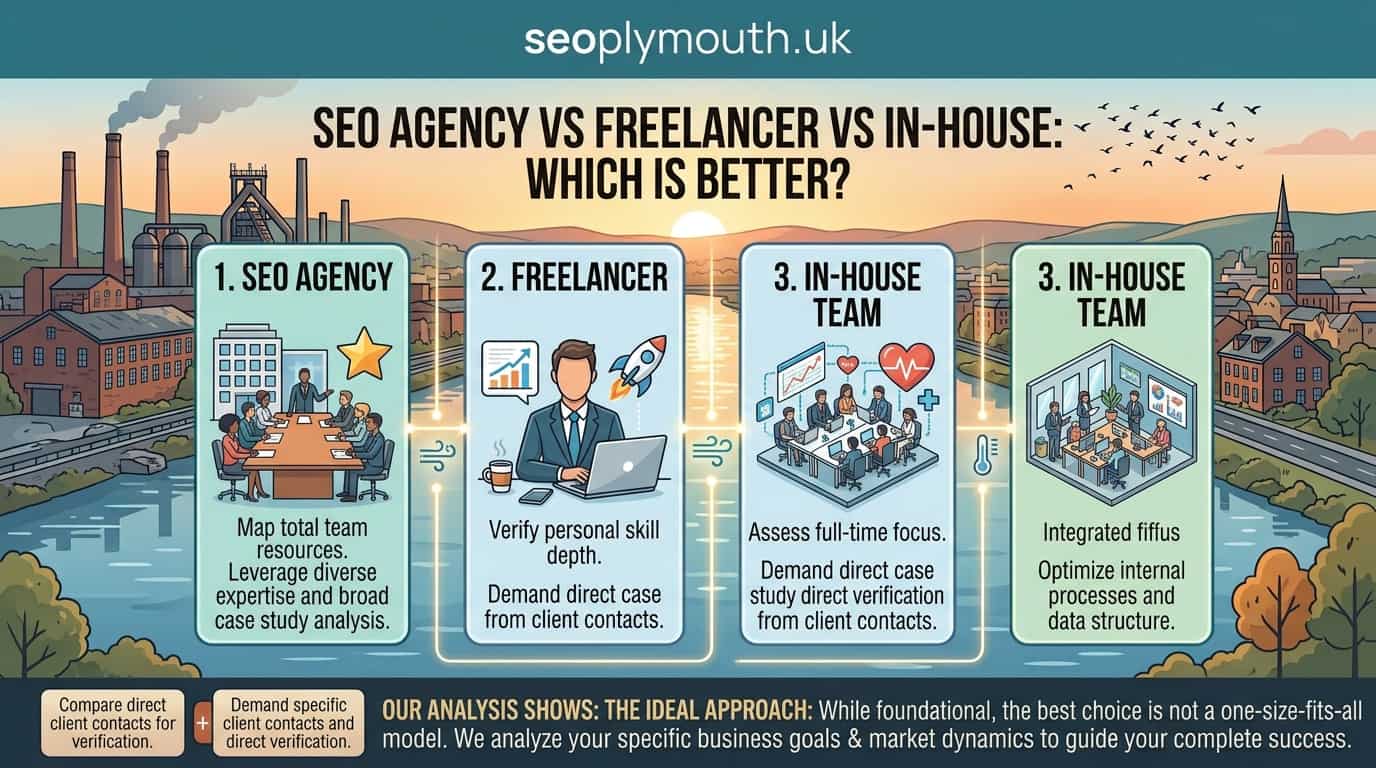
The SEO agency vs freelancer vs in-house decision depends on the amount of work required, available budget, internal expertise, desired control and how quickly the business needs to build search visibility.
A freelancer can be a suitable choice for a clearly defined project or a business requiring one specialist. An agency provides access to several skills and greater delivery capacity. An in-house hire offers direct control and deeper familiarity with the business but creates a fixed employment commitment.
None of the three models is automatically best for every Plymouth business. The correct choice begins with the work that actually needs to be completed.
Direct Answer
Choose an SEO freelancer when:
- The scope is limited and clearly defined
- One specialist can complete most of the work
- The business has someone internally who can manage implementation
- Budget flexibility matters
- The website is relatively small
- The work does not require several specialists simultaneously
Choose an SEO agency when:
- The campaign requires technical, content, local and authority work
- Several services or locations need support
- The business needs broader delivery capacity
- There is no internal SEO team
- Strategy and implementation are both required
- Continuity matters if one person becomes unavailable
Choose an in-house SEO employee when:
- SEO creates enough ongoing work for a full-time role
- The organisation needs close daily coordination
- Internal teams can support implementation
- The business can fund salary, recruitment, software and training
- Search is a central long-term acquisition channel
- The organisation can recruit and supervise the right person
A hybrid arrangement may work best when an internal marketing employee coordinates an agency or specialist freelancer.
SEO Agency vs Freelancer vs In House: Quick Comparison
| Factor | SEO agency | Freelancer | In-house hire |
|---|---|---|---|
| Range of expertise | Usually broad | Usually specialised | Depends on the individual |
| Delivery capacity | Moderate to high | Limited by one person | Dedicated to one employer |
| Direct control | Moderate | Moderate | High |
| Business familiarity | Develops over time | Develops over time | Usually strongest |
| Recruitment commitment | Low | Low | High |
| Continuity | Team can provide cover | Dependent on one person | Dependent on employee retention |
| Communication | Account or project contact | Usually direct with specialist | Direct internal access |
| Software access | Often included | May be included | Business usually pays |
| Ability to scale | Generally easier | Limited by availability | Requires further hiring |
| Best suited to | Multi-skill campaigns | Defined specialist work | Businesses with continuous demand |
The decision should not be made solely by comparing a monthly retainer with an employee’s salary or a freelancer’s project fee. Each option includes different responsibilities and resources.
What Does an SEO Agency Provide?
An SEO agency normally brings together several capabilities under one agreement.
Depending on the provider, these may include:
- SEO strategy
- Technical analysis
- Keyword research
- Content planning
- Service-page optimisation
- Local search work
- Internal linking
- Digital PR or link acquisition
- Analytics and conversion tracking
- Reporting
- Website implementation
- Project management
The main advantage is not simply having more people. It is having access to different skills when the campaign requires them.
A technical problem may need a developer. A weak service page may require a content specialist. Local visibility may require Google Business Profile work, while authority building requires research and outreach.
One person can possess several of these skills, but it is less common for one person to have deep expertise and substantial delivery capacity in all of them.
Advantages of an SEO Agency
Access to several skills
An agency may assign different tasks to people with relevant experience.
This can be useful when a campaign contains:
- A website migration
- Technical corrections
- New landing pages
- Local visibility problems
- Content production
- Authority building
- Conversion tracking
Greater delivery capacity
An agency can usually complete more simultaneous work than one freelancer or one in-house employee.
This matters when a business has:
- A large website
- Several services
- Multiple locations
- Seasonal deadlines
- A substantial content backlog
- Development requirements
Operational continuity
If one team member is unavailable, another may be able to continue the work.
This does not guarantee uninterrupted delivery, but it reduces total dependence on one individual.
Existing tools and processes
Agencies often maintain their own SEO, reporting, crawling and project-management software.
The client should still confirm which tools are used and whether it will have access to the relevant accounts and data.
Limitations of an SEO Agency
Less direct access to every specialist
Communication may pass through an account manager or project lead.
This can be efficient, but it may also slow decisions if the agency’s internal process is unclear.
Competing client priorities
An agency manages several clients. The business should understand:
- Who manages the account
- How much capacity is allocated
- How quickly requests are handled
- How priorities are agreed
- What happens when urgent work appears
Variable service quality
The word “agency” does not prove expertise.
Some agencies provide genuine strategy and implementation. Others outsource most work, produce generic content or rely on automated reports.
The business must evaluate the people and process behind the agency name.
What Does an SEO Freelancer Provide?
An SEO freelancer is an independent specialist who works with clients directly.
Freelancers may focus on:
- Technical SEO
- Content strategy
- Local SEO
- Ecommerce SEO
- Link building
- Website migrations
- Analytics
- SEO consulting
- WordPress optimisation
Others provide a broader service covering several areas.
The freelancer model can work particularly well when the business knows what it needs and can find someone with the matching specialism.
Advantages of an SEO Freelancer
Direct communication
The person discussing the strategy is normally the person completing the work.
This can make communication faster and reduce information passing through several people.
Specialist expertise
A freelancer may have deep experience in one particular area.
For example, a business planning a complex migration might hire a technical specialist instead of retaining a broader provider.
Flexible engagement
Freelancers may offer:
- Hourly consulting
- Fixed projects
- Audits
- Monthly retainers
- Implementation support
- Training
This can suit a smaller business that is not ready for a larger campaign.
Lower organisational overhead
A freelancer may charge less than an agency because there are fewer management and operating costs.
Lower fees do not automatically mean better value. The comparison must account for scope, capacity and expertise.
Limitations of an SEO Freelancer
Capacity depends on one person
One freelancer has a limited number of working hours.
A campaign may slow down if that person:
- Becomes ill
- Takes leave
- Accepts too many clients
- Encounters another urgent project
- Lacks time for implementation
Skills may be concentrated
A technically strong freelancer may not be the best content writer. A content strategist may not be able to implement development changes.
The business may need to coordinate several freelancers.
Less built-in continuity
If the freelancer ends the engagement, knowledge and documentation must transfer to another provider.
The client should ensure that it owns:
- Website accounts
- Analytics
- Search Console
- Content
- Reports
- Research
- Tracking configurations
- Login credentials
What Does an In-House SEO Employee Provide?
An in-house SEO employee works directly for the organisation.
The role may include:
- Daily performance monitoring
- Working with internal developers
- Coordinating writers
- Managing agencies
- Reviewing product or service launches
- Building internal SEO processes
- Training other departments
- Setting website requirements
- Reporting to management
The greatest advantage is proximity to the business.
An internal employee can learn:
- Products and services
- Commercial priorities
- Customer questions
- Internal approval processes
- Subject specialists
- Website history
- Seasonal patterns
- Operational restrictions
This knowledge can improve prioritisation and implementation.
Advantages of an In-House Hire
Full attention on one organisation
An employee does not divide contracted hours among several clients.
SEO priorities can be integrated into everyday marketing and website decisions.
Closer internal relationships
The employee can work directly with:
- Developers
- Sales teams
- Service managers
- Compliance teams
- Directors
- Designers
- Content specialists
This can make implementation faster when the organisation is prepared to cooperate.
Stronger business understanding
An internal employee may develop a deeper understanding of the company than an external provider.
This is particularly useful for complex services, specialist terminology and large websites.
Greater control
The organisation controls working priorities, processes and access.
However, control only creates value when management understands how to support and evaluate the role.
Limitations of an In-House Hire
Recruitment risk
It can be difficult to assess SEO ability during recruitment.
Candidates may be strong in one area but weaker in another. A business may unknowingly recruit:
- A content specialist for a technical problem
- A strategist without implementation skills
- A junior employee for a senior role
- A general marketer with limited SEO experience
Employment costs
The cost extends beyond salary.
It may include:
- Employer contributions
- Pension
- Recruitment
- Software
- Equipment
- Training
- Management time
- Annual leave
- Benefits
One person still has limited skills and capacity
An in-house employee is not automatically equivalent to an entire agency team.
The organisation may still require external support for:
- Development
- Digital PR
- Advanced technical work
- Content production
- Website migrations
- Specialist audits
Retention risk
When an in-house specialist leaves, the organisation may lose knowledge and momentum.
Documentation and shared account ownership remain essential.
Start by Defining the Actual SEO Work
Before choosing a delivery model, identify what is preventing progress.
Possible needs include:
- Technical problems
- Weak commercial pages
- Poor local visibility
- Missing location pages
- Insufficient authority
- Unclear website structure
- Content overlap
- Inaccurate tracking
- Low conversion rates
- A planned migration
- Lack of internal implementation
The correct provider depends on the problem.
A business should not hire a full-time content-focused employee when its main obstacle is a technically broken website. It should not appoint a link-building specialist when its service pages do not explain what it offers.
Begin with an assessment of the website and its search data.
Decision Matrix for a Plymouth Business
| Business situation | Likely starting model | Reason |
|---|---|---|
| Small website needing a defined audit | Freelancer or agency project | Limited initial scope |
| Local business needing ongoing SEO | Agency or experienced freelancer | Regular but not necessarily full-time work |
| Multi-location business | Agency or in-house lead plus agency | Requires scale and coordination |
| Large website with internal developers | In-house SEO | Daily collaboration may be valuable |
| Business preparing for migration | Technical freelancer or specialist agency | Specific high-risk expertise required |
| Organisation publishing content daily | In-house SEO or content lead | Continuous editorial involvement |
| Business with no marketing team | Agency | Strategy, management and delivery required |
| Business with a marketing manager | Freelancer, agency or hybrid | Internal coordination already exists |
| Short-term specialist problem | Freelancer | Narrow expertise may be sufficient |
| SEO is a major acquisition channel | In-house lead plus external specialists | Continuous ownership and specialist support |
This table provides a starting point. Provider quality matters more than the label.
When Is an Agency the Better Fit?
An agency may be the better fit when a Plymouth business needs several forms of work at the same time.
For example, a local service company may require:
- Technical corrections
- Service-page improvements
- Google Business Profile work
- Local content
- Review strategy
- Internal links
- Conversion tracking
- Authority building
Hiring and coordinating separate specialists for every task may create more management work than appointing one capable provider.
An agency may also be appropriate when the business cannot yet justify a full-time employee but needs consistent monthly implementation.
When Is a Freelancer the Better Fit?
A freelancer may be the better choice when:
- The website is small
- The work is clearly defined
- One skill is particularly important
- The owner wants direct communication
- Internal staff can implement recommendations
- The budget does not support a broader engagement
- The business needs temporary specialist support
For example, a company may hire a freelancer to:
- Audit a migration
- Improve a Google Business Profile
- Conduct keyword research
- Review website architecture
- Correct analytics
- Train an internal content team
The engagement should still have clear deliverables, access arrangements and ownership terms.
When Is an In-House Hire Justified?
An in-house hire becomes more reasonable when there is enough valuable work to occupy the role consistently.
Signs may include:
- The website changes every week
- Several departments affect organic search
- The business operates many locations
- New products or services launch frequently
- Search contributes substantial revenue
- External recommendations repeatedly wait for internal implementation
- Content requires close expert coordination
- Management wants SEO included in everyday decisions
The business must also be ready to manage the employee properly.
Hiring someone without authority, development support or access to internal experts can leave them unable to implement improvements.
What Is a Hybrid SEO Model?
A hybrid model combines internal ownership with external expertise.
Examples include:
- Marketing manager plus SEO agency
- In-house SEO lead plus technical freelancer
- Internal content team plus external strategist
- In-house specialist plus digital PR agency
- Agency strategy plus internal implementation
- Freelancer audit plus developer implementation
This arrangement can provide:
- Strong internal knowledge
- External specialist skills
- Flexible capacity
- Clear accountability
- Reduced dependence on one provider
The responsibilities must be documented. Otherwise, each party may assume another person is handling implementation.
Compare Scope, Not Just Price
Three proposals may appear to offer “monthly SEO” while including very different work.
Compare:
- Research
- Technical implementation
- Content writing
- Content uploading
- Local SEO
- Link acquisition
- Development
- Reporting
- Meetings
- Tracking
- Conversion improvements
- Strategy
- Available hours or capacity
A lower monthly price may exclude implementation. A more expensive proposal may include content, technical work and specialist support that would otherwise require several suppliers.
Ask each provider to explain:
- What will be completed?
- What will only be recommended?
- Who performs each task?
- What requires additional payment?
- What depends on the client?
- How are priorities selected?
- How will results be evaluated?
How Should Expertise Be Assessed?
Do not rely only on:
- Website design
- Number of followers
- Awards
- Sales presentations
- Rankings for the provider’s own brand
- Unverified testimonials
- Tool screenshots
Ask for evidence relevant to the work.
Useful evidence may include:
- Explanation of the proposed strategy
- Examples of completed work
- Case studies with sufficient context
- Search Console comparisons
- Technical recommendations
- Content examples
- References
- Reporting samples
- A clear prioritisation process
The provider should explain why a result occurred and what work contributed to it.
A later article in this cluster will explain how to verify an SEO case study once that guide is published.
Questions to Ask an SEO Agency
Ask:
- Who will manage the campaign?
- Who performs technical work?
- Who writes and reviews content?
- How many clients does the team manage?
- What happens if an account manager leaves?
- Is implementation included?
- How are monthly priorities selected?
- Which tools and accounts will the business own?
- How will local search be addressed?
- What will be reported?
- How often will communication occur?
- How can the agreement be ended?
An agency should answer these questions without hiding behind vague process descriptions.
Questions to Ask a Freelancer
Ask:
- Which areas of SEO do you specialise in?
- What work do you not provide?
- How much monthly capacity is available?
- Will you implement recommendations?
- What happens during illness or leave?
- Do you use subcontractors?
- Who owns completed content and research?
- How will progress be documented?
- Which communication channel will be used?
- What is the notice period?
The answers should clarify the risks associated with depending on one person.
Questions to Ask Before Hiring In-House
Ask internally:
- Is there enough work for a full-time role?
- What level of experience is required?
- Who will supervise the employee?
- Can the business assess candidates properly?
- Will developers implement technical changes?
- Who will produce content?
- What software budget is available?
- Can the role access decision-makers?
- What outcomes will define success?
- Which external specialists may still be required?
A vague job description often produces a poor hiring decision.
What Should a Small Plymouth Business Choose?
Many small local businesses do not initially need a full-time SEO employee.
Their websites may contain:
- A homepage
- Several service pages
- Location information
- Contact pages
- A small supporting blog
- A Google Business Profile
An experienced freelancer or appropriately sized agency may provide enough capacity without creating a permanent role.
The decision depends on whether the business needs:
- Advice only
- Implementation
- Content
- Local search work
- Website development
- Ongoing campaign management
A small business with no internal marketing support may benefit more from an agency that can manage several functions. A business with a capable marketing employee may work effectively with a specialist freelancer.
What Should a Growing Plymouth Business Choose?
A growing company may need a hybrid arrangement.
An internal marketing manager can provide:
- Business context
- Access to subject experts
- Approval
- Commercial priorities
- Coordination
An external agency or freelancer can provide:
- Search expertise
- Technical assessment
- Research
- Specialist implementation
- Additional capacity
This can delay the need for a full internal SEO department while maintaining internal control.
How Should Local SEO Affect the Decision?
Businesses serving Plymouth and surrounding areas may require expertise in:
- Google Business Profile
- Local search intent
- Service-area pages
- Location pages
- Reviews
- Local citations
- Map visibility
- Local links
- Consistent business information
- Call and enquiry tracking
A provider should explain how local work differs from general content publishing.
Businesses dependent on geographically relevant customers can review our local SEO services in Plymouth to understand the areas an ongoing local campaign may include.
How Should Performance Be Measured?
The chosen model should be accountable for work and outcomes.
Useful measures may include:
- Relevant non-branded impressions
- Organic clicks
- Visibility for commercial searches
- Local map visibility
- Calls
- Enquiry forms
- Bookings
- Qualified leads
- Conversion rates
- Revenue where tracking permits
- Completed technical work
- Improved priority pages
Rankings and traffic are useful, but they should not be reported without connection to commercially relevant pages and enquiries.
A business should also distinguish between deliverables and outcomes. A provider can control whether agreed work is completed but cannot responsibly guarantee a specific ranking or number of enquiries.
Warning Signs Across All Three Models
Be cautious when an agency, freelancer or candidate:
- Guarantees first-position rankings
- Cannot explain the strategy
- Focuses only on publishing volume
- Avoids discussing implementation
- Promises a fixed result within days
- Uses private link networks without disclosure
- Will not clarify account ownership
- Reports only traffic
- Ignores conversion tracking
- Recommends pages without checking existing content
- Uses the same plan for every business
- Cannot explain risks
- Avoids documenting completed work
- Requires control of accounts the business should own
Poor practice can occur under any delivery model.
Making the Final Decision
Use the following sequence:
1. Diagnose the website
Identify the actual technical, content, local and authority problems.
2. Define the required work
Separate strategy, implementation, writing, development and outreach.
3. Estimate ongoing demand
Decide whether the work is temporary, monthly or sufficient for a full-time employee.
4. Select the delivery model
Choose an agency, freelancer, in-house employee or hybrid arrangement.
5. Evaluate candidates
Compare relevant experience, process, capacity and communication.
6. Define ownership
Ensure the business owns its website, analytics, content and campaign accounts.
7. Establish measurement
Agree how completed work and business outcomes will be reported.
8. Review the arrangement
Reassess whether the selected model still fits as the business grows.
SEO Support for Plymouth Businesses
Businesses requiring a coordinated campaign can learn more about SEO support for Plymouth businesses. The appropriate scope should reflect the website’s existing performance, commercial priorities and implementation requirements.
Before comparing costs, review the available SEO packages and pricing and confirm exactly what research, content, technical work and reporting are included.
Frequently Asked Questions
Is an SEO agency better than a freelancer?
Not automatically. An agency usually offers broader expertise and capacity, while a freelancer may provide more direct access and specialist knowledge. The better option depends on the work required.
Is it cheaper to hire an SEO freelancer?
A freelancer may charge less because of lower overheads, but the comparison must account for scope, tools, capacity and implementation.
When should a business hire an in-house SEO specialist?
An in-house role is most suitable when the organisation has enough continuous work, internal implementation support and budget for recruitment, salary, tools and training.
Can a small business manage SEO internally?
It can, provided someone has sufficient knowledge, time and access to implement the work. Occasional training or specialist support may still be needed.
Can an agency work with an internal marketing team?
Yes. A hybrid arrangement can combine internal business knowledge with external strategy, expertise and delivery capacity.
Should I hire several freelancers?
Several specialists can provide strong expertise, but the business must coordinate priorities, communication and implementation across them.
Who should own Search Console and Analytics?
The business should own its principal website, analytics and search accounts. External providers can receive appropriate access.
How long should an SEO agreement last?
The appropriate term depends on the scope, but the agreement should explain notice periods, ownership and what happens when the engagement ends.
Is local SEO a separate specialism?
Local search requires additional work involving Google Business Profile, location relevance, reviews, citations and map visibility. A provider serving local businesses should understand these areas.
Can one in-house employee do everything?
One employee may manage many areas, but advanced technical work, development, content production or digital PR may still require additional support.
Final Answer
The SEO agency vs freelancer vs in-house decision should be based on the work required rather than the title attached to the provider.
An agency may fit a Plymouth business requiring several skills, ongoing implementation and greater capacity.
A freelancer may fit a clearly defined project or business requiring one specialist with direct communication.
An in-house hire may fit an organisation with enough continuous work, internal support and budget to justify a permanent role.
A hybrid model can combine internal business knowledge with external expertise.
Before deciding:
- Diagnose the current problems
- Define the work
- Compare complete scope rather than headline price
- Check relevant expertise
- Clarify account ownership
- Agree responsibilities
- Establish meaningful measurement
- Review the arrangement as the business changes
The best option is the one capable of completing the right work consistently while fitting the organisation’s resources and management capacity.