


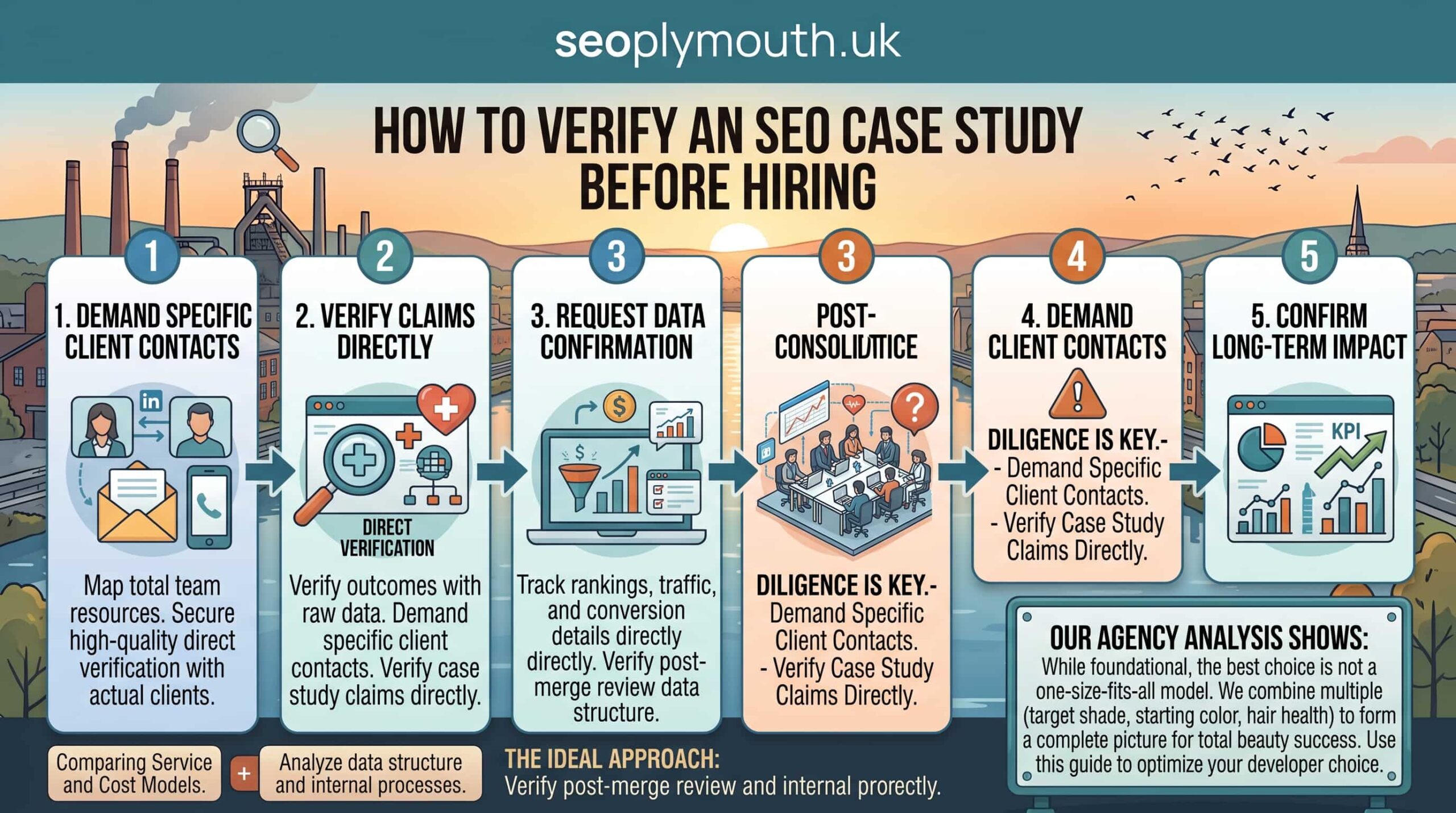
Learning how to verify an SEO case study helps a business distinguish useful performance evidence from attractive screenshots, selective statistics and unsupported claims.
A credible case study should explain the client’s starting position, the work completed, the measurement period and the business outcomes. It should also acknowledge factors that affected performance and clarify which results can reasonably be connected with the SEO campaign.
A graph showing increased traffic may be genuine without proving that the provider caused the increase or that the additional visitors generated enquiries.
Direct Answer
To verify an SEO case study, check:
- Whether the business and website can be identified
- The starting and ending dates
- The original performance baseline
- Whether the evidence comes from Search Console or analytics
- Whether branded and non-branded traffic are separated
- Which pages and queries improved
- What work the provider completed
- Whether the website changed in other ways
- Whether traffic produced enquiries, sales or bookings
- Whether seasonal demand affected the comparison
- Whether the claimed result can be independently checked
- Whether the client can confirm the provider’s involvement
The strongest case studies connect completed work with relevant search visibility and commercial outcomes without pretending that every improvement has one simple cause.
How to Verify an SEO Case Study: Evidence Checklist
| Evidence | What to check | Warning sign |
|---|---|---|
| Website identity | Real website or adequately explained anonymisation | No way to confirm the business exists |
| Measurement period | Clear beginning and ending dates | “Results achieved quickly” without dates |
| Baseline | Starting clicks, rankings, traffic or enquiries | Only the final result is shown |
| Data source | Search Console, analytics, CRM or call tracking | Unnamed dashboard screenshot |
| Query relevance | Commercial and non-branded searches | Growth comes mainly from brand searches |
| Landing pages | Pages connected with actual services | Traffic comes from unrelated articles |
| Completed work | Specific technical, content or local actions | “We optimised the website” |
| Conversions | Calls, forms, bookings or sales | Traffic reported without outcomes |
| Attribution | Other marketing and website changes disclosed | SEO receives credit for everything |
| Client confirmation | Testimonial, reference or identifiable relationship | Generic quote without context |
A business does not need access to every client account. It should still expect enough information to understand what happened and judge whether the example is relevant.
What Should an SEO Case Study Include?
A useful case study should tell a complete story.
Client context
The reader should understand:
- What the business provides
- Whether it serves local, national or international customers
- The size and type of website
- Important services or products
- Target locations
- The level of competition
- The website’s condition before the campaign
Results from a well-established ecommerce website cannot automatically be applied to a new local service website.
Initial problems
The case study should explain what was limiting performance.
Possible problems include:
- Important pages were not indexed
- Service pages did not match search intent
- Several pages competed for the same keywords
- Internal linking was weak
- The Google Business Profile was incomplete
- Website authority was limited
- Content did not address relevant searches
- Tracking was inaccurate
- The website had recently migrated
- Visitors reached the website but did not enquire
Without this context, the reader cannot determine whether the provider solved a problem similar to its own.
Work completed
The case study should identify specific actions.
Examples include:
- Correcting crawling and indexing problems
- Consolidating overlapping pages
- Improving priority service pages
- Developing useful location pages
- Reorganising internal links
- Improving titles and search snippets
- Creating supporting content
- Correcting local business information
- Strengthening practitioner or team profiles
- Earning relevant links
- Implementing call and form tracking
- Improving calls to action
A long list is not automatically better. The work should correspond with the problems identified at the beginning.
Measurement period
The case study should state:
- When work began
- When major changes were implemented
- Which periods are being compared
- Whether the data is monthly, quarterly or annual
- Whether the business is seasonal
- Whether the latest period is complete
SEO results often develop over time. Comparing one unusually weak month with one unusually strong month can exaggerate the apparent improvement.
Outcomes
The case study should show what changed.
Possible outcomes include:
- Relevant non-branded impressions
- Organic clicks
- Commercial-page visibility
- Local map visibility
- Calls
- Enquiry forms
- Bookings
- Sales
- Revenue
- Conversion rate
- Cost per qualified lead
Traffic and rankings are useful evidence, but they should not replace business outcomes where those outcomes can be measured responsibly.
Verify the Data Source
The appearance of a screenshot can provide clues about its source.
Google Search Console
Search Console may show:
- Clicks
- Impressions
- Average click-through rate
- Average position
- Queries
- Pages
- Countries
- Devices
- Search appearance
A Search Console graph can demonstrate a change in organic search activity, but it does not prove:
- Lead quality
- Revenue
- Which provider caused the change
- Whether branded demand increased
- Whether another channel influenced searches
- Whether the website changed ownership or purpose
Ask which filters were applied and which dates are being compared.
Google Analytics
Analytics may show:
- Organic sessions
- Landing pages
- Engagement
- Key events
- User journeys
- Ecommerce revenue
- Attribution reports
Ask whether tracking remained consistent throughout the comparison.
A website redesign, analytics migration, consent-platform change or altered event configuration can create apparent growth or decline that does not reflect actual performance.
Rank-tracking software
Ranking tools can show movement for selected keywords.
Check:
- Which location was tracked
- Which device was used
- Whether map rankings were included
- Whether the terms were selected before the campaign
- Search volume and commercial relevance
- Whether the provider added easier keywords later
- Whether the ranking belongs to the intended page
A campaign can report a high percentage of improved keywords by selecting a favourable keyword set.
CRM and call tracking
CRM, booking and call-tracking data may provide stronger commercial evidence.
Ask how the provider identified:
- New enquiries
- Qualified leads
- Organic calls
- Form submissions
- Bookings
- Sales
- Existing customers
- Spam enquiries
A click on a phone number is not the same as a connected and qualified call.
Check the Date Range Carefully
The comparison period can change how impressive a result appears.
Month-on-month comparisons
These can be distorted by:
- Seasonality
- Short-term campaigns
- Public holidays
- Weather
- Incomplete months
- Temporary demand changes
Year-on-year comparisons
These can reduce some seasonal distortion but may still be affected by:
- Website redesigns
- Business expansion
- New services
- Price changes
- Brand advertising
- Market changes
Before-and-after comparisons
These can be useful when implementation dates are clear.
However, SEO changes do not always produce immediate effects. The case study should explain when the work was completed and how long it took for meaningful changes to appear.
Businesses evaluating expectations can also read how long SEO takes to produce results.
Check the Starting Position
Large percentage increases can begin from very small numbers.
For example:
- Traffic rising from 10 to 30 visits is a 200% increase
- Enquiries rising from one to three is also a 200% increase
- Revenue rising from £100 to £300 is a 200% increase
The percentage is mathematically accurate but incomplete without the actual numbers.
Ask for:
- Starting value
- Ending value
- Absolute increase
- Percentage increase
- Length of the comparison
A credible case study may report both:
Organic enquiries increased from 12 to 25 per month, representing an increase of approximately 108%.
This provides more context than:
Enquiries increased by 108%.
Separate Branded and Non-Branded Growth
Branded searches contain the company, product or practitioner name.
Non-branded searches describe a need without naming the business.
Examples:
| Branded | Non-branded |
|---|---|
| Example Plumbing Plymouth | emergency plumber Plymouth |
| Example Dental Clinic | private dentist near me |
| Example Solicitors | conveyancing solicitor Plymouth |
| Example Store | running shoes online |
Branded growth can be valuable, but it may result from:
- Paid advertising
- Social media
- Public relations
- Offline marketing
- Customer referrals
- Increased brand awareness
An SEO campaign intended to reach new customers should normally show whether relevant non-branded visibility also improved.
Ask:
- Did clicks increase for the business name?
- Did commercial non-branded queries improve?
- Which service pages gained visibility?
- Did new visitors reach the correct landing pages?
A case study combining all queries may hide the real source of growth.
Check Which Pages Produced the Growth
Sitewide growth can be driven by one article that has little relationship with revenue.
The business should identify whether performance improved across:
- Homepage
- Service pages
- Product categories
- Location pages
- Articles
- Branded pages
- Recruitment pages
- Support content
Suppose an article gains 20,000 visits for an informational question but produces no enquiries. That may demonstrate content and ranking ability, but it does not prove the campaign improved commercial performance.
A stronger local-service case study might show:
- Increased visibility for priority service pages
- More visits from the target area
- More calls or forms
- Higher qualified-enquiry volume
The value of the traffic depends on where it lands and what visitors do next.
Verify the Queries
Ask to see examples of the searches that improved.
Check whether they are:
- Relevant to the business
- Commercially useful
- Located in the target market
- Non-branded
- Assigned to the correct page
- Likely to bring suitable customers
Be cautious when a case study emphasises:
- Extremely long queries with no measurable demand
- Terms unrelated to the company’s main services
- The client’s brand name
- Keywords that rank only because they are unique
- Rankings from a location outside the target market
A ranking has limited value if no appropriate customer uses the query.
Check Whether the Evidence Is Selective
Case studies naturally present successful work, but the provider should not manipulate the evidence.
Potential signs of selective reporting include:
- Cropped screenshots hiding dates
- Charts without axis labels
- Only one unusually strong day displayed
- Rankings without search locations
- Percentages without starting values
- Traffic without landing pages
- Enquiries without qualification
- Revenue without attribution
- A graph ending before a decline
- Comparison periods of different lengths
Ask for a broader period where necessary.
A twelve-month graph may provide more context than a screenshot showing only the strongest six weeks.
Ask What Else Changed
SEO rarely operates in isolation.
During the case-study period, the client may also have:
- Increased paid advertising
- Run a television or radio campaign
- Gained media coverage
- Opened a new location
- Changed its brand
- Added new services
- Reduced prices
- Improved sales handling
- Launched social campaigns
- Redesigned the website
- Experienced unusual market demand
- Acquired another company
These changes do not invalidate the SEO results. They affect attribution.
A responsible provider should acknowledge significant factors instead of claiming sole credit for every improvement.
Check Whether the Provider Completed the Work
A case study may belong to an agency even when:
- The client’s internal team wrote the content
- Another developer implemented technical changes
- A separate PR agency earned links
- The client already had strong authority
- Another provider managed local search
- The website redesign was handled elsewhere
Ask:
- What did you recommend?
- What did you implement?
- What did the client complete?
- Were other agencies involved?
- Which work existed before your appointment?
This helps determine whether the provider can reproduce the relevant part of the project.
Verify the Client Relationship
When the client is identified, a business may check:
- Whether the company exists
- Whether the website matches the case study
- Whether the client lists or follows the provider
- Whether a testimonial appears elsewhere
- Whether the dates are plausible
- Whether archived website versions support the story
For a substantial contract, ask whether the provider can supply a reference.
A short client conversation can confirm:
- The provider actually completed the work
- Communication quality
- Reliability
- Reporting
- Implementation
- Problems encountered
- Whether the client would hire the provider again
Not every client will agree to provide a reference, particularly where confidentiality applies. The provider should still offer another reasonable form of evidence.
How Should an Anonymised Case Study Be Judged?
Anonymisation is not automatically suspicious.
Clients may prohibit the public disclosure of:
- Business name
- Website
- Revenue
- Commercial strategy
- Customer information
- Internal performance
An anonymised case study should still provide sufficient context.
Look for:
- Industry
- Website type
- Approximate size
- Geographic market
- Starting problem
- Work completed
- Dates
- Data sources
- Outcomes
- Reasons for anonymisation
The provider may be able to show additional evidence privately under appropriate confidentiality.
Be cautious if every case study is anonymous and no client relationship can ever be verified.
Check the Case Study’s Relevance
A genuine result may still be irrelevant to your business.
Compare:
- Industry
- Business model
- Website size
- Location
- Competition
- Starting authority
- Available budget
- Internal resources
- Campaign length
- Services provided
A national ecommerce case study does not automatically demonstrate ability to manage a small local service campaign.
Likewise, ranking a well-established domain may not show that the provider can build visibility for a new website.
Ask the provider to explain how the example relates to your situation.
Evaluate Conversion Evidence
The strongest case studies connect organic search with meaningful actions.
Possible conversion evidence includes:
- Calls
- Form submissions
- Appointment bookings
- Quote requests
- Ecommerce sales
- Qualified leads
- Revenue
- Repeat purchases
Ask how conversions were defined.
For example:
- Was every phone-number click counted as a call?
- Were spam submissions removed?
- Were existing customers included?
- Was revenue attributed using last click?
- Were offline sales connected with the original enquiry?
- Did tracking exist before the campaign?
A case study should acknowledge measurement limitations rather than presenting attribution as perfect.
Evaluate Local SEO Evidence
For a local business, ask whether the case study includes:
- Google Business Profile performance
- Local map visibility
- Calls from local listings
- Direction requests
- Website visits
- Location-specific queries
- Local landing pages
- Reviews
- Target-area enquiries
Map rankings can change according to the searcher’s location.
A screenshot from one point in a city does not prove uniform visibility across the entire service area. Grid-based tracking may provide broader context, but it should still be interpreted alongside enquiries.
Case Study Claims That Need More Evidence
“We increased traffic by 500%”
Ask:
- From what starting number?
- Over what period?
- Which pages grew?
- Was the traffic relevant?
- Did enquiries increase?
“We ranked the client number one”
Ask:
- For which query?
- In which location?
- On which device?
- For how long?
- Was it branded?
- Did it produce business?
?
“We generated 100 leads”
Ask:
- How was a lead defined?
- Were they qualified?
- Which channel produced them?
- Were existing customers included?
- How many became sales?
“We doubled revenue”
Ask:
- Was revenue tracked through analytics or the CRM?
- Did prices change?
- Did paid advertising increase?
- Were other channels involved?
- Was the increase seasonal?
“We fixed the website”
Ask:
- Which issues were identified?
- Which changes were implemented?
- How were they validated?
- What performance changed afterwards?
Specific questions reveal whether the claim has substance.
Warning Signs in an SEO Case Study
Be cautious when:
- The client cannot be identified without explanation
- Dates are missing
- Screenshots are heavily cropped
- Only percentages are shown
- Search volume is not discussed
- Every example reports extraordinary growth
- No difficulties are mentioned
- Traffic is presented as revenue
- Branded and non-branded searches are combined
- The work completed is vague
- The provider cannot explain attribution
- The case study does not match the proposed service
- Rankings are shown without location
- Testimonials use stock photographs
- Results are guaranteed based on another client’s experience
One warning sign does not necessarily prove deception. Several together justify closer examination.
Positive Signs in an SEO Case Study
A credible case study often includes:
- Clear client context
- Specific dates
- Starting and ending figures
- Named data sources
- Relevant queries and pages
- Work connected with diagnosed problems
- Conversion evidence
- Limitations
- Other contributing factors
- Realistic timelines
- Client confirmation
- Lessons from work that did not perform as expected
A provider willing to discuss limitations may be more trustworthy than one presenting every campaign as a perfect success.
Questions to Ask the Provider
Use these questions during evaluation:
- Can you identify the client?
- Why was this example selected for us?
- What was the starting position?
- Which dates are being compared?
- Which data sources were used?
- Can you show the absolute figures?
- Did branded searches contribute to the increase?
- Which pages generated the growth?
- Which queries improved?
- What work did your team complete?
- What work did the client complete?
- Were other providers involved?
- Did paid or offline marketing change?
- How were leads defined?
- How many enquiries were qualified?
- Can the client confirm the engagement?
- What did not work?
- Which parts could reasonably apply to our business?
- What would be different about our campaign?
- What outcome can you responsibly commit to?
The quality of the explanation matters as much as the screenshot.
Compare Case Studies Across Different Provider Models
Agencies, freelancers and in-house candidates may present evidence differently.
An agency may show a campaign involving several specialists. A freelancer may demonstrate deep responsibility for one part of a larger project. An in-house candidate may show results achieved with substantial support from internal departments.
Before deciding which arrangement fits the business, read our comparison of an SEO agency vs freelancer vs in house.
In every case, identify:
- The individual’s actual responsibility
- Available supporting resources
- Budget
- Authority of the website
- Time invested
- Implementation support
Do not assume the person presenting the result completed every part alone.
A Simple SEO Case Study Verification Score
Score each category from zero to two.
| Category | 0 points | 1 point | 2 points |
|---|---|---|---|
| Client identity | Unverifiable | Anonymised with limited context | Identified or privately verified |
| Dates | Missing | Partial | Clear comparison period |
| Baseline | Missing | Percentage only | Starting and ending figures |
| Data source | Unnamed | Some evidence | Recognisable and explained |
| Queries and pages | Missing | Partial examples | Relevant breakdown |
| Work completed | Vague | General list | Specific implemented actions |
| Conversions | None | Basic action count | Qualified commercial outcomes |
| Attribution | SEO receives all credit | Limited discussion | Other factors acknowledged |
| Relevance | Unrelated example | Some similarities | Closely relevant |
| Client confirmation | None | Testimonial only | Reference or verified relationship |
Possible interpretation:
- 0–7: Evidence is too limited
- 8–13: Some useful evidence, but important questions remain
- 14–17: Generally credible with minor gaps
- 18–20: Strong, contextual and reasonably verifiable
The score is a due-diligence tool, not a scientific guarantee.
How Much Proof Is Reasonable to Request?
The amount of evidence should reflect the size and risk of the agreement.
For a small one-off project, a clear example, explanation and contract may be sufficient.
For a substantial long-term commitment, the business may reasonably request:
- Detailed case studies
- Reporting samples
- References
- Clear deliverables
- Ownership terms
- Measurement definitions
- Relevant experience
- Explanation of implementation
A provider must still protect client confidentiality and personal information.
The objective is not to demand unrestricted access to another company’s data. It is to gather enough evidence to make an informed decision.
Using Evidence Without Expecting Identical Results
Even a fully verified case study does not guarantee that another website will achieve the same result.
Outcomes vary according to:
- Existing authority
- Competition
- Website condition
- Budget
- Market demand
- Internal resources
- Implementation speed
- Content quality
- Location
- Brand strength
- Conversion process
The case study should demonstrate capability and process, not promise duplication.
Businesses considering ongoing search support can learn more about SEO for Plymouth businesses and compare the proposed work with the evidence used to support it.
Frequently Asked Questions
Can an SEO case study be faked?
Yes. Screenshots, percentages and testimonials can be altered or presented without context. Verification should examine dates, data sources, website identity, completed work and client confirmation.
Is a Search Console screenshot enough?
No. It may demonstrate organic clicks and impressions, but it does not show lead quality, revenue, attribution or who completed the work.
Should an SEO agency identify every client?
Not necessarily. Some clients require confidentiality. An anonymised case study should still provide clear context, dates, data sources, work and outcomes.
Are traffic increases proof of SEO success?
They may indicate improved visibility, but the relevance of the traffic, landing pages and resulting enquiries must also be considered.
How can I verify keyword rankings?
Ask for the query, URL, date, device and location. Search Console and independent rank tracking can provide additional context.
Should I contact a case-study client?
For a substantial agreement, requesting a reference can be reasonable. The provider should obtain the client’s permission before sharing contact details.
Can a freelancer use work completed while employed by an agency?
Potentially, but the freelancer should explain their individual role and respect confidentiality and ownership agreements.
Why are percentage increases misleading?
A large percentage can begin from a very small baseline. Ask for both the percentage and absolute figures.
What if the provider cannot share revenue figures?
Revenue may be confidential. The provider may be able to show qualified enquiries, bookings, anonymised figures or other appropriate evidence.
Does a case study guarantee similar results?
No. It demonstrates previous experience under particular conditions. Another website may have different competition, authority, resources and challenges.
Final Answer
Knowing how to verify an SEO case study requires more than checking whether its graph rises.
A business should examine:
- Client context
- Starting position
- Dates
- Data sources
- Absolute figures
- Branded and non-branded performance
- Queries and landing pages
- Work completed
- Conversions
- Attribution
- Client confirmation
- Relevance to the proposed campaign
The strongest case study explains what happened, why the provider believes the work contributed and which limitations remain.
Treat case studies as evidence of capability—not as guarantees that another business will receive an identical result.